
Educator, Researcher, Evaluator: Dr. Ja’Dell Davis Reads the World, Then Changes It
Updated: Dec 19, 2025
When Ja’Dell Davis, Ph.D., was still a budding sociologist, she took to heart three powerful words she’d read from her academic mentor: “Read the world.”
Now a researcher and evaluator at the Wisconsin Center for Education Research (WCER, University of Wisconsin–Madison), Davis has built her career around this very practice. But in fact, this keen perception was a skill she’d been sharpening since childhood, forged through the experiences of a Black family navigating spaces that did not always affirm their worth.
“This was lifelong,” Davis says. “Even early on, I was spurred to read the world in particular ways.”
Davis’s parents grew up in the segregated South, then migrated from Louisiana to Los Angeles, where Davis was ultimately raised. “We were surrounded by people from the South who were building community and lives in really important ways,” she explains. “And [my parents] were really explicit that our cultural understandings as Louisianians are important. And our way of talking and being is beautiful. We don’t need to be anybody else.”
Even as she brushed up against subtle and overt forms of racism, Davis held steadfast to her family’s lesson: that her Blackness had a history and value, and no one could take that away. So instead of caving to the pressure to disappear, Davis moved in the opposite direction – making it her mission to help people of color claim their dignity.
“I spent my entire life noticing how insidious the messages are for especially Black and brown people to not love themselves,” Davis reflects. “That makes me say, ‘Okay, we don’t have to go along with this. How do we do something different?”
Teaching as Liberation
For Davis, the most powerful place to start this work was with young people: in the classroom, in after-school spaces, in college access programs. After leaving Los Angeles for college and graduate school in Pennsylvania, she became a teacher in the Philadelphia public school system, where her focus quickly shifted beyond the curriculum.
“Yes, I taught content, but I also thought, ‘How do I take my own liberties in this content to support what I am building in people?” Davis reflects. “And it wasn’t just, ‘I want you to be a good person.’ I’m thinking that for brown people, Black people, I want you to love yourselves in a world that explicitly wants you to hate yourself.”
Painfully, even the teaching environment often betrayed this core message. After weathering the same micro- and macro-aggressions she’d faced all her life, Davis found herself effectively pushed out of the school system, dismissed by fellow educators who refused to see her worth.
Although she’d held no illusions about the pervasiveness of racism in public education, experiencing it so viscerally from her fellow educators stung deeply. “That’s when I made the decision to move into college access, because that’s also what I was doing in the classroom anyway,” she explains.
Forced Out, Propelled Forward
For Davis, leaving the classroom only deepened her commitment. Ever-impassioned, she poured herself into her college access work, supporting counselors and youth workers as they helped students transition from high school into college – often into institutions not designed for their thriving.
“I knew what my own college experience was like, and I didn’t want young people to think they just had to grin and bear it,” she says. “I wanted them to enter institutions in a way that centers their well-being, to know they don’t have to assimilate in every way they’re told.”
Ultimately, this clarity drove Davis towards deeper study. Nudged by her mentors, she – admittedly begrudgingly, at first – attained her sociology Ph.D. from the University of Wisconsin-Madison, where she continues her work as a researcher and evaluator, “following an ethos of culturally responsive and equitable evaluation.”
A key focus of her research, Davis explains, is understanding the everyday, exploring how micro-level actions can spark structural transformations.
“That includes thinking about structures and the language people have for structural inequality,” she says. “It means really taking a structural perspective and analysis on everyday ‘isms’. And as a part of that, I always try to think of, what are we doing in the everyday context – with ourselves, but also in our interactions with people every day. What are those micro-level things that accrue to those structural pieces? We can’t take the everyday out of the structural, knowing that the everyday can impact what happens at the structural level.”
Civic Engagement on a Park Bench
In the academic setting, Davis applies these concepts to her college access work. But for the savvy sociologist, this micro-level mission does not end in the classroom or conference room; it extends into the community, where she brings this ethos to everyday interactions.
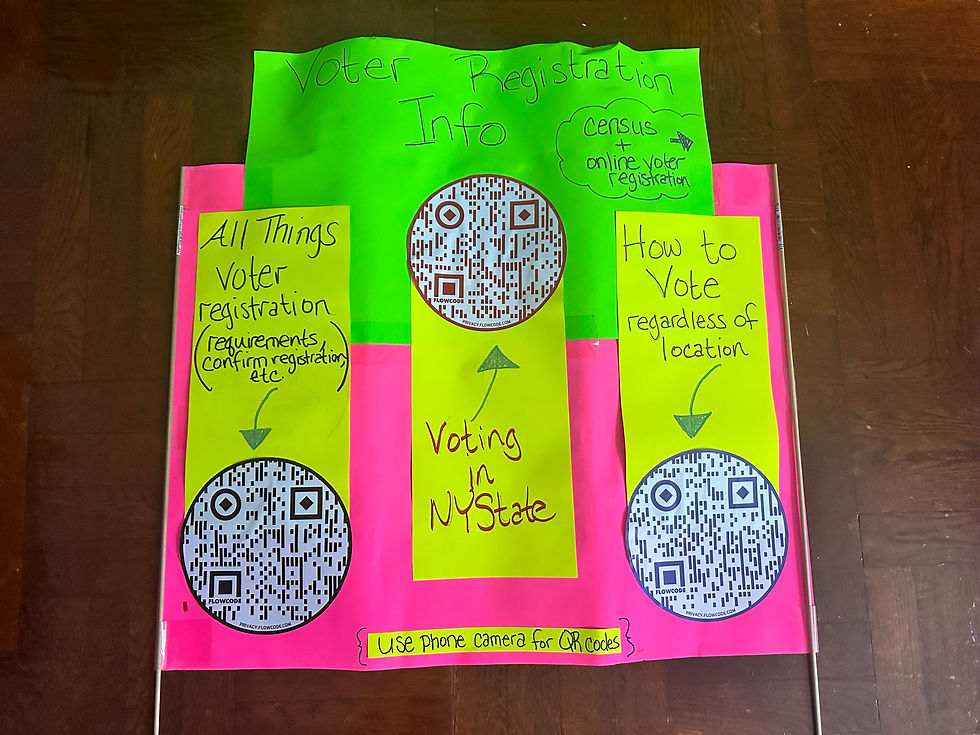
And in 2020, during the COVID-19 pandemic, Davis carried it into her neighborhood – right onto a New York City park bench. At a moment when civic engagement felt both fragile and desperately needed, she created two handwritten posters, one in English and Spanish, each with QR codes linking to voter registration and census forms.
Davis sat on the park bench with the posters propped beside her, reading and greeting people as they passed. Some people paused to scan the QR codes; others specified that they had already completed the forms online. One elder hurried home so he could retrieve his census paperwork, then returned to the bench so Davis could walk him through the process, step by step, in Spanish.
“I wanted to be sure that folks who are voting have the information they need, but also the support they need,” Davis explains. “But also, knowing that so many Black and brown people had died and the numbers were dwindling, just existentially, I want our votes to count. I want our presence to be counted.”
The Power of Authentic Connection
For Davis, the park-bench project was part of a broader philosophy – that civic engagement lives in small, meaningful moments of human connection. When she’s not sitting in a public park beside handmade posters, she’s making eye contact with every stranger she passes, sharing a powerful glance that, however fleeting, shows people they are truly seen.
“I make people say hi to me on the street,” Davis points out. “There’s something folks are told about New York that you keep to yourself, mind your own business. I don’t believe that. I’ve been here long enough to know that people speak on the street. And there’s always at least one person whose face lights up because they were not expecting someone to say hi."
It’s these small exchanges that propel Davis forward, even when fighting the status quo can feel exhausting. From a smile on the subway to a colleague’s praise about her work, “every day, someone reflects back to me that this work makes sense,” she says. “The feedback gives me hope.”
As for those inspired to find civic engagement at the micro-level, Davis’s advice echoes her mentor’s wise words: read the world, honor your emotions – even if that means tapping into anger – and seek comfort and connection in your tribe.
“Whatever is motivating you, find your people,” she says. “Not just people you call your community, but people who can hold your anger with you. Allow yourself to be angry and at the same time understand you’re not alone; you’re not powerless.”
And of course, strive to break out of your comfort zone; try something different from the status quo. “Hold hands with discomfort, figure out what connection can look like, and just try it,” Davis urges. “And when you fail, try again.”
For resources to share and connect with your community, visit https://www.civichealthall.com/resources.



Comments